

Helix DSP ULTRA S – DSP processor
The Helix DSP ULTRA S DSP processor is the processor with the most outputs in our range: 12 outputs, 8 high-level inputs up to 32 V and two 64-bit DSP chips. It is the right choice for active systems with more than 10 channels, where each speaker has its own amplifier and the factory radio stays.
- Processor without amplifiers: requires separate amplifiers
- 12 outputs for active systems with more than 10 channels
- 8 high-level inputs up to 32 V, factory radio stays
Pickup available at Supersound
Usually ready in 24 hours
Helix DSP ULTRA S – DSP processor
Supersound
Podmilščakova 46
1000 Ljubljana
Slovenia
We can install the product for you in our workshop in Ljubljana. We have more than 20 years of experience and more than 3500 completed installations. Before installation, we check what your vehicle needs for flawless operation and send you a quote.
To book an appointment, call +386 70 285 229 or write to us via the form. The workshop is open Mon–Fri 8:00–16:00.
Installation carried out in our workshop comes with a lifetime warranty. Products carry the manufacturer's standard warranty.
Delivery
Delivery costs €5.90 per order, regardless of parcel weight. Delivery is free for orders over €100. Parcels are delivered by GLS.
Payment
You can pay by payment card, bank transfer or cash on delivery. With cash on delivery, you pay the GLS courier in cash or by card.
Description
Twelve channels for a system in which every speaker has its own amplifier
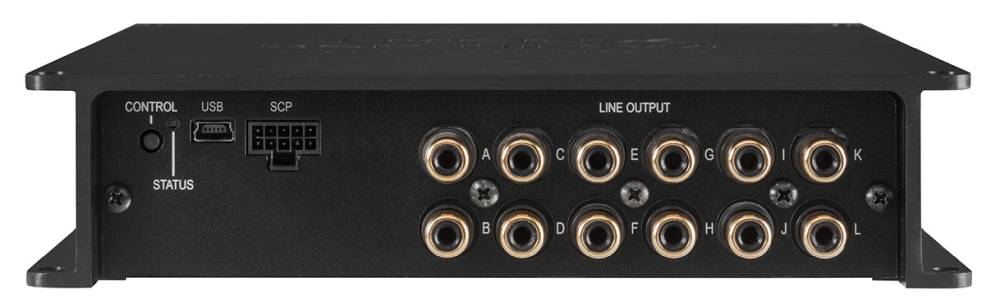
The Helix DSP ULTRA S DSP processor is a 12-channel sound processor without built-in amplifiers. It processes the radio signal and sends it through 12 separate outputs to external amplifiers, so every speaker gets its own channel, its own filter and its own volume.
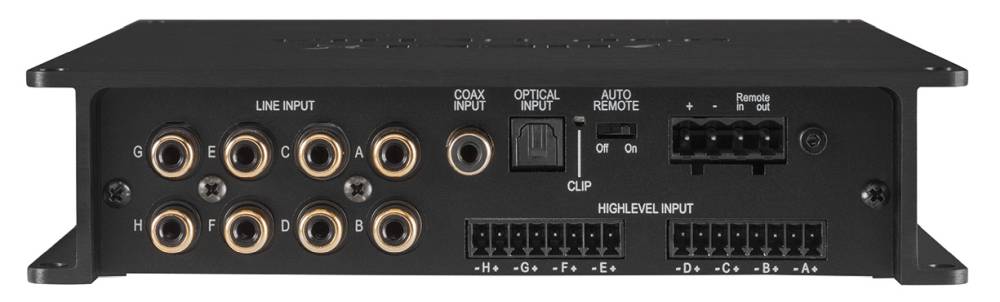
It is designed for large active systems, for example with front 3-way speakers, rear speakers, a centre speaker and a subwoofer, each on its own channel. It connects to a factory or aftermarket radio through 8 high-level inputs up to 32 V (connection to the radio's speaker outputs), 8 RCA inputs, or optical and coaxial digital inputs.
Two 64-bit Analog Devices DSP chips perform 2.4 billion operations per second at 96 kHz, and 32-bit AKM converters reach a signal-to-noise ratio of 117 dB and distortion below 0.0004% at the digital input. The manufacturer presents it as an upgrade of its predecessor with an improved signal path.
Even with 12 channels, tuning stays clear: TuneEQ automatically corrects the frequency response after a measurement, and Virtual Channel Processing keeps order in a complex system. For systems of up to 10 channels the DSP PRO MK3 is cheaper; you can find all models among the DSP processors.
What changes in your car
- Every speaker has its own channel and its own setting, so the soundstage stands in front of you on the dashboard.
- We tune the sound for the driver's seat, and the vocals stand in the centre in front of you.
- The factory radio, display and steering wheel buttons stay as they are.
- When no music plays, the processor switches off the amplifiers and the battery does not drain.
- Later you can expand the system with a Bluetooth or USB module, without replacing the processor.
Advantages and technology
Connects to almost any radio, error-free (8 high-level inputs with ADEP.3, RCA, SPDIF)
The processor accepts the signal from a factory radio or a powerful factory amplifier, and the radio does not report errors. The high-level inputs accept 4–32 V with continuously adjustable sensitivity, the RCA inputs 1–8 V, the optical input 12–96 kHz and the coaxial input 12–192 kHz. The ADEP.3 circuit is made for the diagnostics of factory radios, and Auto Remote switches the processor on when there is a signal.
Precise setup of every speaker (TwinDSP Power, Virtual Channel Processing)
We tune each of the 12 outputs separately. Two 64-bit DSP chips with 2.4 billion operations per second simultaneously process 8 inputs, 8 virtual channels and 12 outputs. VCP allows flexible combining of channels, and separate matrices for line, SPDIF and HEC/AUX define the signal path.
Sound tuned for the driver's seat (time alignment up to 20 ms, Reverse Time Alignment)
Sound from all the speakers reaches you at the same time, so the soundstage is in front of you. The delay is adjustable up to 20 ms per channel, and the processor also supports reverse time alignment.
Faster tuning and correction of the factory radio (TuneEQ, ATM, ISA, Input EQ, ACO)
We tune the system faster and more precisely. TuneEQ corrects the frequency response after one measurement per channel or pair of channels, ATM (Automatic Time Measurement) measures the delay times automatically, and ISA and Input EQ measure and correct the factory radio's settings. The 32-bit ACO co-processor handles all of this.
Full bass, vocals in the centre, sound that follows the volume (Augmented Bass Processing, RealCenter, DLC, RTC)
The bass is full even when listening at lower volume, and the voice is in the centre. Augmented Bass Processing with Dynamic Bass Enhancement and SubXpander adds subharmonics between 50 and 100 Hz, RealCenter creates a centre signal from the front left and right channels, and DLC and RTC adapt the highs and lows to the volume.
Clean sound and reliable power supply (AKM Velvet Sound, TI/BurrBrown OPA, Start-Stop, ground lift)
The sound stays clean even when the engine starts. AKM Velvet Sound 32-bit converters and OPA operational amplifiers give an SNR of 117 dB, the power supply withstands a drop to 6 V for up to 5 seconds, and the ground lift switch helps eliminate ground-loop hum.
Ready for expansion (HEC, Smart Control Port, Power Save Mode)
You complete the system without replacing the processor. Into the HEC slot you add a module for Bluetooth HD or high-resolution audio over USB, and to the Smart Control Port a remote control such as the Helix CONDUCTOR or DIRECTOR. Power Save Mode switches off the amplifiers when there is no signal.
Is the Helix DSP ULTRA S the right choice for your car?
The closest alternative is the Helix DSP PRO MK3. The difference is in the number of outputs and the range of inputs.
| Helix DSP ULTRA S | Helix DSP PRO MK3 | |
|---|---|---|
| Outputs | 12 | 10 |
| High-level inputs | 8 (4–32 V, continuous) | 8 (4–32 V, 3 levels) |
| RCA inputs | 8 (1–8 V) | 8 (2–4 V) |
| Digital inputs | optical, coaxial | optical, coaxial |
| SNR (digital input) | 117 dB | 116 dB |
| Dimensions | 40 × 177 × 170 mm | 40 × 177 × 150 mm |
| Price | 1.199 € | 899 € |
Choose the Helix DSP ULTRA S if the system has 11 or 12 channels or a source with an RCA output above 4 V. For systems of up to 10 channels the DSP PRO MK3 is enough. If you want a processor and amplifier in one unit, a simpler choice is a DSP car amplifier, for example the Helix V TWELVE DSP MK2.
Installer's opinion

“We install the Helix DSP ULTRA S when we build the system channel by channel, with a separate amplifier for every speaker. Tuning does the most: we set each speaker individually for the driver's seat, and the factory radio stays.”
Specifications
| Frequency range | 10–44.000 Hz |
|---|---|
| Number of channels | 10 or more |
| Number of DSP channels | 12 |
| Signal-to-noise ratio | 117 dB (digital input), 111 dB (analog) |
| Distortion (THD) | < 0.0004% (digital input), < 0.0008% (analog) |
| Operating voltage / start-stop | 9.6–17 V; Start-Stop down to 6 V (5 s) |
| Inputs | 8 × high-level (4–32 V) 8 × RCA (1–8 V) 1 × optical SPDIF (12–96 kHz) 1 × coaxial SPDIF (12–192 kHz) |
| Outputs | 12 × RCA (8 V) |
| Dimensions | 40 × 177 × 170 mm |
| Built-in DSP | Yes |
| High-level input | Yes |
| Digital input (SPDIF) | Yes |
| Expansion (HEC / Bluetooth) | Yes |